NIO EV Smart Factory
unknown · unverified
- No deployment-specific evidence recorded.
Watch changes · Evidence history and cited research export (API access) · Plan a pilot
Each pillar is scored 0–100 from published specs, then weighted into the HMX. Compare it only with other humanoid robots — each category uses its own reference scales. See the full methodology →
Became the world's first humanoid robot torchbearer at a national multi-sport games (Nov 2025); an earlier Kuavo generation ran Huawei HarmonyOS.
Legacy mentions are unverified. A partnership or announcement is not proof of an active deployment. Evidence labels do not change HMX v2 scoring.
NIO EV Smart Factory
unknown · unverified
China Southern Power Grid & China Mobile (1,200 km 5G-A substation inspection)
unknown · unverified
FAW Group
unknown · unverified
Haier Group
unknown · unverified
Jiangsu Hengtong
unknown · unverified
Evidence is attached to each value. Robot-wide source links do not verify every field. A source about an older value cannot support the current specification.
Declared shared origins are grouped. Distinct domains and unclassified origins do not establish independent evidence.
No field-specific evidence recorded. This value is unverified at field level.
Declared shared origins are grouped. Distinct domains and unclassified origins do not establish independent evidence.
No field-specific evidence recorded. This value is unverified at field level.
Declared shared origins are grouped. Distinct domains and unclassified origins do not establish independent evidence.
No field-specific evidence recorded. This value is unverified at field level.
Declared shared origins are grouped. Distinct domains and unclassified origins do not establish independent evidence.
No field-specific evidence recorded. This value is unverified at field level.
Declared shared origins are grouped. Distinct domains and unclassified origins do not establish independent evidence.
No field-specific evidence recorded. This value is unverified at field level.
Declared shared origins are grouped. Distinct domains and unclassified origins do not establish independent evidence.
No field-specific evidence recorded. This value is unverified at field level.
Declared shared origins are grouped. Distinct domains and unclassified origins do not establish independent evidence.
No field-specific evidence recorded. This value is unverified at field level.
Declared shared origins are grouped. Distinct domains and unclassified origins do not establish independent evidence.
No field-specific evidence recorded. This value is unverified at field level.
Declared shared origins are grouped. Distinct domains and unclassified origins do not establish independent evidence.
No field-specific evidence recorded. This value is unverified at field level.
Declared shared origins are grouped. Distinct domains and unclassified origins do not establish independent evidence.
No field-specific evidence recorded. This value is unverified at field level.
Declared shared origins are grouped. Distinct domains and unclassified origins do not establish independent evidence.
No field-specific evidence recorded. This value is unverified at field level.
Declared shared origins are grouped. Distinct domains and unclassified origins do not establish independent evidence.
No field-specific evidence recorded. This value is unverified at field level.
Declared shared origins are grouped. Distinct domains and unclassified origins do not establish independent evidence.
No field-specific evidence recorded. This value is unverified at field level.
Declared shared origins are grouped. Distinct domains and unclassified origins do not establish independent evidence.
No field-specific evidence recorded. This value is unverified at field level.
Declared shared origins are grouped. Distinct domains and unclassified origins do not establish independent evidence.
No field-specific evidence recorded. This value is unverified at field level.
Declared shared origins are grouped. Distinct domains and unclassified origins do not establish independent evidence.
No field-specific evidence recorded. This value is unverified at field level.
Declared shared origins are grouped. Distinct domains and unclassified origins do not establish independent evidence.
No field-specific evidence recorded. This value is unverified at field level.
Declared shared origins are grouped. Distinct domains and unclassified origins do not establish independent evidence.
No field-specific evidence recorded. This value is unverified at field level.
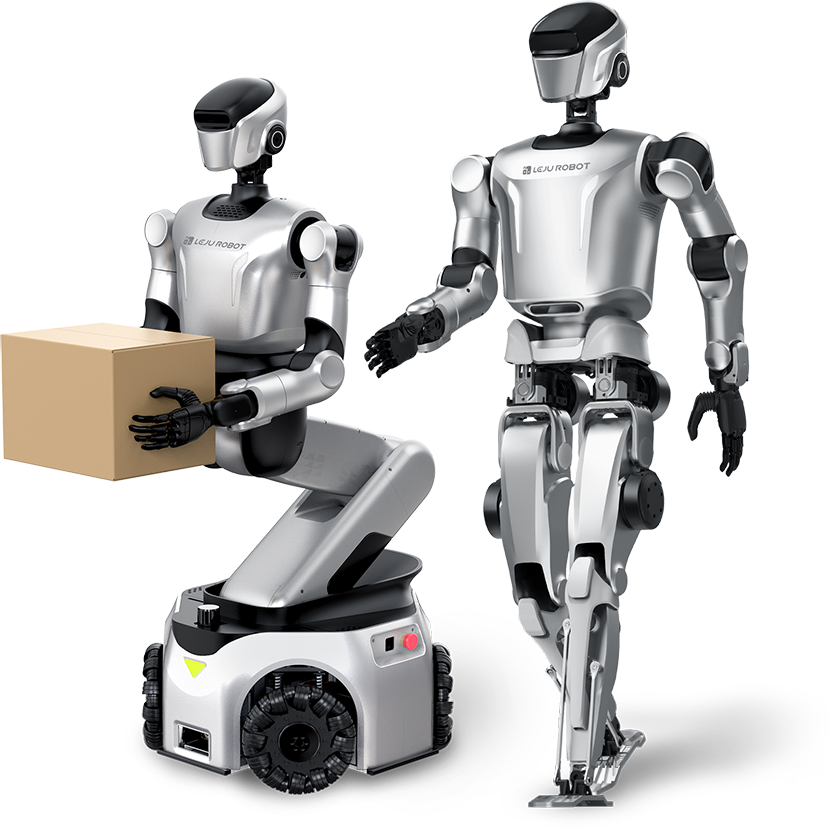
Kuavo-5 is a humanoid robot from Leju Robot in China, and it is commercially available. It scores 72.7 on the Humanoid Metric, ranking 11th of 169 — in the top 10%.
On the leaderboard it sits between Apptronik Apollo (HMX 73.8) and NEURA Robotics 4NE-1 (HMX 72.7).
It is at or above the category median on every machine pillar, most of all mobility & locomotion: 75.6 against a median of 30.0.
By the published specifications, it runs longer per charge than 86% of the 69 other humanoid robots publishing a runtime (7 h) and carries more payload than 75% of the 106 other humanoid robots publishing a payload (20 kg).
Its published price of $45,500 is below 45% of the 62 other humanoid robots with a public price — nearer the expensive end, with a median published price of $42,000.
On autonomy, it has demonstrated completing tasks on its own. 5 deployment claims are on record, none yet backed by a customer, the press or the vendor.
Its specifications carry a medium-confidence grade from 3 cited sources, as of 2026-07.
Task capability is not inferred from hardware specifications or general autonomy labels. Find robots for a task →
No task-specific evidence recorded. Capability remains unknown.
Machine-readable: HIS Layer 0 manifest at /robot/leju-kuavo5/manifest.json, with a free API key · what's this?
The Leju Robot Kuavo-5 has a published price of $45,500.
Published specifications: payload 20 kg, speed 1.39 m/s, runtime 7 h, degrees of freedom 41, degrees of freedom per hand 5, height 173 cm, weight 63.5 kg.
The Leju Robot Kuavo-5 has demonstrated completing tasks on its own. The grade reflects demonstrations, not marketing claims.
On the HMX, the Leju Robot Kuavo-5 scores 72.7 and the Apptronik Apollo 73.8. The Leju Robot Kuavo-5 leads on autonomy & intelligence, mobility & locomotion and commercial readiness & deployment; the Apptronik Apollo leads on manipulation & dexterity, hardware & engineering and ecosystem & viability.
The Leju Robot Kuavo-5 is made by Leju Robot, in China.

Nothing is deleted: every version of this record is kept, with what changed in each.